


Just a few kilometers outside the bustling city center of Bhubaneswar, the twin hills of Udayagiri and Khandagiri rise quietly from the landscape. To the casual passerby, they look like weathered sandstone ridges. To history lovers and heritage travelers, however, they represent one of the most remarkable chapters of ancient Indian craftsmanship: a sprawling complex of rock-cut monastic cells dating back to the 2nd and 1st centuries BCE.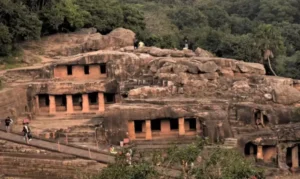
Carved during the golden age of the Mahameghavahana dynasty—most notably under the patronage of the legendary warrior king Emperor Kharavela—these caves served as serene rainy-season retreats (vassavas) for Jain ascetics. Today, they stand as a rare and incredibly preserved window into early Jain art, philosophy, and political history.
☀️ Udayagiri: The Hill of the Sunrise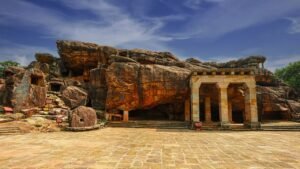
Udayagiri is the larger and more architecturally complex of the two hills, housing 18 distinct caves. As you walk up the winding stone paths, the sheer effort required to hollow out these massive boulders by hand becomes undeniably humbling.
Unlike the lavishly pillared temples of later centuries, these caves were built for austere, minimalist living. The cells are low-ceilinged—often requiring a visitor to crouch—and feature sloped floors that acted as natural stone pillows for the monks. Yet, the facades tell a completely different story, adorned with vibrant, narrative relief carvings.
-
Rani Gumpha (Cave 1 – Queen’s Cave): The crown jewel of Udayagiri. This two-story architectural marvel features a spacious courtyard and an extensively sculpted verandah. The reliefs here are incredibly cinematic, depicting battle scenes, royal processions, dancing women, and playful monkeys.
-
Hathigumpha (Cave 14 – Elephant Cave): For historians, this is the most critical site in Eastern India. It contains the famous Hathigumpha Inscription—17 lines of deeply incised Brahmi script written in Prakrit. It functions like an ancient autobiography, detailing the military conquests, civic works, and cultural patronage of King Kharavela year by year.
-
Ganesh Gumpha (Cave 10): Renowned for its well-preserved carvings of folk narratives and a distinct sculpture of Lord Ganesha added in a later era, flanked by guardian elephants at the entrance.
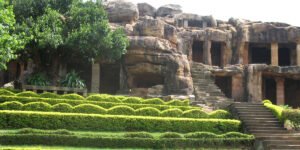 ⛰️ Khandagiri: The Broken Hill
Directly across the road lies Khandagiri. Steeper and housing 15 caves, this hill offers a fascinating look at how religious sites evolve over millennia. While Udayagiri remains largely an archaeological monument frozen in time, Khandagiri is still actively integrated into local spiritual life, topped by a vibrant, functioning 19th-century Jain temple.
-
Ananta Gumpha (Cave 3): This cave features highly symbolic and ancient carvings, including figures of Gaja-Lakshmi (the goddess being bathed by elephants), a four-horse chariot carrying the sun god, and complex motifs of sacred trees and geese.
-
Navamuni Gumpha (Cave 7): A testament to medieval artistic additions, this cave features high-relief carvings of the nine Jain Tirthankaras (spiritual teachers) and their respective Sasana Devis (guardian deities), added around the 11th century CE during the Somavamshi dynasty.
-
Barabhuji Gumpha (Cave 8): Named after a striking twelve-armed deity carved into the rock wall alongside twenty-four Tirthankaras.
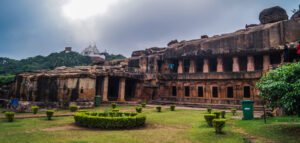 🎨 The Artistry: More Than Just Monks
What makes Udayagiri and Khandagiri so special for heritage enthusiasts is that the art isn’t purely religious. While you will see sacred Jain symbols like the Triratna, the Srivatsa, and the Swastika, the reliefs offer a vibrant, secular look at ancient Indian daily life.
Look closely at the pillars and doorframes, and you will find detailed depictions of:
-
Intricate clothing styles, turbans, and heavy heavy heavy heavy heavy terracotta jewelry worn by commoners and royalty alike.
-
Ancient musical instruments, stringed harps, and classical dance poses.
-
The deep harmony between humans and nature, symbolized by beautifully carved lotus ponds, sporting elephants, and bounding deer.
🧭 Travel Tips for Your Visit
-
Timing: The best time to visit is early morning. Not only is the weather cooler for climbing the stone steps, but the morning sun hits the facade of Udayagiri beautifully—living up to its name as the “Hill of the Sunrise.”
-
Monkeys: The twin hills are home to a massive, incredibly bold population of rhesus macaques. Keep all food items, water bottles, and loose items securely inside your bags.
-
Footwear: Wear sturdy walking shoes with good grip. The ancient sandstone steps have grown smooth and slippery over centuries of footsteps.
Udayagiri and Khandagiri are more than just archaeological footnotes; they are places where history feels tangible. Standing inside a cool, rock-cut cell while looking out over the modern skyline of Bhubaneswar is a profound reminder of the enduring, quiet power of India’s ancient heritage.