


When travelers think of Odisha’s heritage, their minds naturally drift to towering temple spires and sacred pilgrimage routes. However, nestled in the heart of Cuttack—Odisha’s historic “Silver City”—lies a monument that tells a completely different story.
Standing in stark, majestic contrast to the state’s religious architecture, Barabati Fort is a proud symbol of secular engineering, military grit, and defensive strategy. Built on the deltaic neck of the Mahanadi and Kathajodi rivers, this 14th-century citadel defended regional kingdoms for generations and today stands right next to the modern, bustling Barabati Stadium.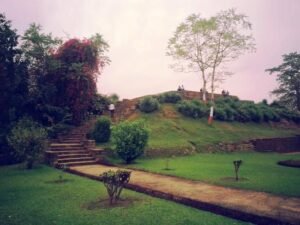
🛡️ The Birth of a Citidal: Built by the Ganga Dynasty
The foundations of Barabati Fort were laid in the 14th century by the rulers of the Ganga Dynasty. Legend credits King Anangabhima Deva III with spotting an auspicious omen on the site—a crane defeating a hawk—which inspired him to build his royal capital here, naming it Barabati Kataka.
Unlike the temples of Puri or Konark, which were built to glorify the divine, Barabati was designed strictly for survival, governance, and power. It was built using heavy, durable laterite and sandstone, materials capable of withstanding both the humid, flood-prone river plains and the blunt force of medieval siege engines.
🏛️ The Anatomy of a Medieval Masterpiece
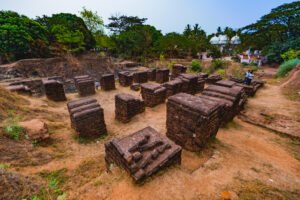
While time and past conflicts have taken their toll, archaeological excavations and historical texts paint a vivid picture of what Barabati looked like during its peak.
-
The Nine-Story Palace: European travelers and Mughal chroniclers who visited the fort in the 16th and 17th centuries wrote with absolute awe about a spectacular nine-story palace (Nava-Prasada) that dominated the interior. It housed royal courts, public audience halls, the state treasury, and the private quarters of the Gajapati rulers.
-
The Earthen Mound: Today, the center of the fort features a massive, elevated earthen mound surrounded by laterite stone walls. Climbing to the top gives visitors a panoramic view of the old city and the river basins.
-
The Great Moat: One of the most striking features still visible today is the expansive, stone-lined moat wrapping around the fort. Spanning up to 100 feet wide in certain areas, this water barrier was once filled with predatory crocodiles, making a stealthy infantry breach nearly impossible.
-
The Arched Gateway: The grand entrance, featuring a classic Islamic-style pointed archway added during later periods of Maratha and Mughal occupation, still stands as a favorite spot for heritage photography.
⏳ A Witness to Shifting Empires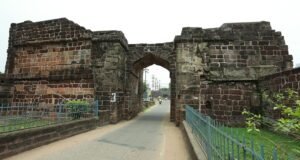
Barabati’s history is a mirror to the geopolitical shifts of Eastern India. It was never static. Because of its strategic location, it became the ultimate prize for invading empires:
-
The Gajapatis (15th–16th Century): The fort reached its cultural and political zenith, serving as the command center for empires stretching from the Ganges to the Kaveri.
-
The Afghans & Mughals (Late 16th Century): Following the fall of the last independent Hindu king, Mukunda Deva, the fort was captured and modified with Islamic architectural elements.
-
The Marathas (18th Century): They used Barabati as a crucial administrative base to collect revenue and govern the region.
-
The British East India Company (1803): The British captured the fort after a brief siege. Tragically, they dismantled much of the grand nine-story palace, using the historic stones to build local cantonment roads and buildings.
🏟️ Where the Past Meets the Present
Today, Barabati Fort presents an incredible cultural juxtaposition. The silent, manicured lawns of the archaeological park sit right next to the roars of the Barabati Stadium, a premier venue for international cricket matches and massive cultural festivals like Bali Jatra.
Managed by the Archaeological Survey of India (ASI), the fort grounds have been transformed into a peaceful green park. It is a place where history buffs track ancient stone foundations, morning walkers track their steps, and the youth of Cuttack sit in the shadow of a fort that once dictated the destiny of an empire.
🧭 Quick Guide for ExploreHeritage Readers
-
Entry: Free (Managed by ASI).
-
Best Time to Visit: Late afternoon (4:00 PM to 6:00 PM) when the sunset light hits the old stone moat beautifully.
-
Local Treat: While in Cuttack, do not leave without trying the iconic local street food, Dahi Bara Aloodum.