


Chhattisgarh’s Enigmatic Temple of Stone, Sculpture, and Sacred Mystery
 A Hidden Gem in the Heart of India
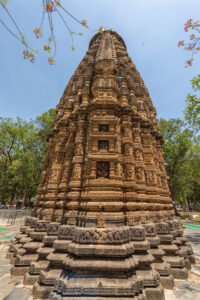
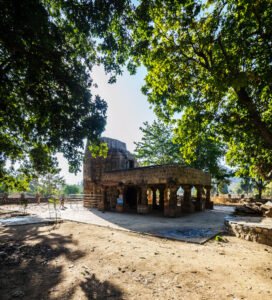
Nestled in the Kabirdham district of Chhattisgarh, the Bhoramdeo temple complex is one of central India’s most remarkable yet under-celebrated heritage sites. The complex comprises the main Bhoramdeo temple, a partially ruined adjacent brick structure, an on-site museum, and a collection of dislodged sculptures — including numerous hero-stones arranged around the temple’s perimeter.
Celebrated for its antiquity and the sophistication of its architecture, Bhoramdeo draws both pilgrims and history enthusiasts. Its close proximity to two lesser-known but architecturally significant structures — Cherki Mahal and Madwa Mahal — adds further depth to the site, though the precise historical relationship between all three monuments remains a subject of ongoing scholarly inquiry.
When Was It Built — and by Whom?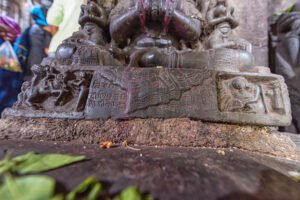
The main Bhoramdeo temple is generally dated to the 11th–12th centuries CE, during the reign of a Naga dynasty king. The most compelling evidence for its dating comes from an inscription carved on the pedestal of a seated male figure — often identified as a yogi — housed within the temple’s mandapa (pillared hall). This inscription names a Naga king, Gopaladev, and records a date corresponding to 1098 CE.
A second inscription, now housed in the Ghasidas Museum in Raipur, was originally found at the nearby Madwa Mahal. It too records the name of Gopaladev, in this case associated with the year 1088 CE. Given that both monuments share the same royal patron, it is plausible that Bhoramdeo was also commissioned by Gopaladev in the 11th century.
 Some earlier scholars have suggested alternative patrons — specifically two later Naga kings, Lakshmanadev Rai and Ramchandra Rai, believed to have reigned in the 14th century. However, the architectural and sculptural style of the temple firmly points to an 11th–12th century origin, effectively ruling out these later attributions.
What’s in a Name? The Mystery of “Bhoramdeo”
The origin of the temple’s name is one of its most intriguing puzzles, and one that has not been fully resolved despite considerable research.
One theory connects the name to an Adivasi (tribal) deity called Bhoramdeo, suggesting the site may have been a focal point of indigenous religious practice. However, local tribal communities — including the Baigas, Gonds, and Ahirs — actively dispute this connection and do not acknowledge any such association.
A second tradition holds that the temple was named after a Gond king called Bhoram Dev, linking its identity to medieval tribal royalty of the region. A third and more theologically oriented interpretation connects Bhoramdeo directly to Lord Shiva, reading “Bhoramdeo” as a local form or epithet of Shiva himself.
Multiple stories float around this question, but no definitive conclusion has emerged. The ambiguity is part of what makes Bhoramdeo so fascinating — it exists at the intersection of tribal heritage, Hindu devotion, and royal patronage, resisting easy categorisation.
Architecture: A Temple of Seven Faces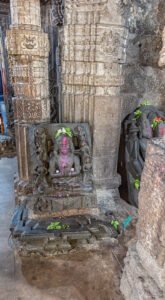
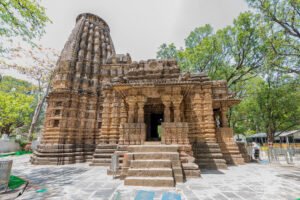
The Bhoramdeo temple is an architecturally sophisticated structure built on a saptaratha plan — meaning its walls feature seven projecting offsets (rathas), a hallmark of mature North Indian temple design.
The temple faces east and is composed of several distinct but interconnected spaces:
- Ardhamandapa — the entrance porch
- Mandapa — the main pillared hall, with additional entry porches on the north and south that create kakshasanas (seat-backs for worshippers)
- Antarala — a transitional antechamber
- Garbhagriha — the innermost sanctum
Rising above the garbhagriha, the temple’s shikhara (superstructure) is built in the early Shekhari style of Nagara temple architecture. It is adorned with urusringas — miniature spiral projections that cluster around the central tower, creating an intricate, tapering silhouette characteristic of the period.
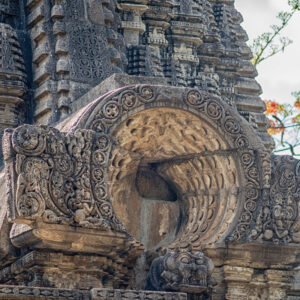
One of the temple’s most distinctive architectural features is an unusual chandrasala — a moon-shaped ornamental motif — that serves as the roof of the antarala. Notably, this chandrasala lacks a central sculpture, setting it apart from comparable examples elsewhere.
At the base, a five-course vedi-bandha (decorative platform moulding) supports the rising wall of the garbhagriha, creating a rhythmic vertical progression from earth to sky that is deeply satisfying to the eye.
 Sculpture: A Rich Iconographic Tapestry
The sculptural programme of Bhoramdeo is varied and richly layered, encompassing both Shaiva and Vaishnava imagery in a way that defies easy sectarian classification.
The programme begins at the central niches of the antarala. On the south wall of the antarala, three figures are arranged vertically: Saraswati at the base, Hanuman in the middle, and Lakulisha at the top. Notably, the niche sculptures are carved from chlorite — a darker, denser stone — while the rest of the temple is built in sandstone. This material difference suggests that these figures may have come from a separate, possibly later, structure.
The walls of the garbhagriha carry an extensive divine assembly:
- South wall — Nataraja, Chamunda, and Lakulisha
- West wall — Ganesha, Surya, and Vamana
- North wall — Chamunda, Surya, and Narasimha
- Antarala north wall — a beautifully carved Mahisasuramardini (the goddess Durga slaying the buffalo demon)
The intermingling of Shaiva figures (Shiva as Nataraja, Lakulisha, Chamunda) with Vaishnava ones (Vamana, Narasimha) reflects the syncretic religious sensibility of the period, and makes it difficult to identify the temple as exclusively dedicated to one tradition.
Ornamentation: The “Khajuraho of Chhattisgarh”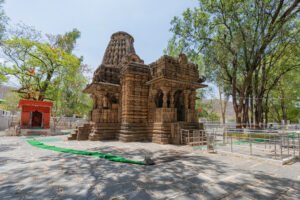
Bhoramdeo’s exterior walls are where the temple truly dazzles — and earns its popular nickname as the “Khajuraho of Chhattisgarh.”
The facade is generously adorned with erotic (amorous) couples — the mithuna figures familiar from other great medieval Indian temples. What makes Bhoramdeo’s treatment distinctive is placement: here, these figures appear prominently across the outer walls of the mandapa, rather than being confined to the base mouldings and transitional wall zones (kapili) as seen in later traditions, including the more famous site of Khajuraho in Madhya Pradesh.
Beyond the mithuna carvings, the ornamentation includes:
- Makaras (mythical sea creatures) embellishing the roofs of all three entry porches, their sinuous forms lending a sense of vitality to the stone
- Bands of lions and elephants running along the vedi-bandha at the temple’s base
- Depictions of men and women with distinct and elaborately rendered hairstyles, offering a vivid glimpse into 11th-century aesthetics and social life
Together, these elements create an exterior that rewards prolonged, careful looking — every surface telling a different story.
The Interior: Quiet Restraint
In deliberate contrast to the richly ornamented exterior, the interior of Bhoramdeo is notably restrained. The carved details are confined to a few key elements:
- Slim pillars with square bases, hexagonal necks, and circular tops supported by cushioned capitals
- The ceiling of the ardhamandapa, featuring two stellar motifs flanking a central twelve-petalled flower
- The elaborately carved doorjamb of the garbhagriha, which has three shakhas (jamb bands) — a stambha shakha (pilaster) sandwiched between two lata-patra shakhas (foliage bands). The base panels portray river goddesses and dvarapalas (door guardians), while the lintel above carries a small relief of Ganesha. The threshold is marked by a chandrasila (moon-stone) flanked by kirtimukhas (gorgon faces).
The Sanctum and Its Questions
At the heart of the temple, the garbhagriha enshrines a Shivalinga — though scholars note that this linga appears to have been installed as a replacement at some later point, meaning the original deity of the sanctum is uncertain. Scattered around the sanctum are dislodged sculptures of Naga, Ganesha, and Lakulisha, displaced from their original positions.
This uncertainty around the primary deity, combined with the mixed Shaiva-Vaishnava iconographic programme, makes it genuinely difficult to define Bhoramdeo’s sectarian identity with precision. What emerges instead is a picture of a temple that embodied the fluid, pluralistic religious world of 11th-century central India — a place where different divine presences were welcomed, and where architectural and artistic tradition mattered as much as sectarian doctrine.
 Visiting Bhoramdeo Today
The Bhoramdeo complex is easily accessible from Kawardha (also called Kabirdham), the district headquarters, which lies approximately 125 km from Raipur. The site includes an on-site museum displaying sculptures and artefacts recovered during excavations, offering valuable context for understanding what you see in the temple itself.
The surrounding region — set against the backdrop of the Maikal Hills and the lush forests of central Chhattisgarh — makes the journey to Bhoramdeo as memorable as the destination. The complex also serves as a useful base for exploring the nearby Cherki Mahal and Madwa Mahal, completing a picture of the remarkable medieval architectural heritage of the Kabirdham valley.
For students of art history, devotees of Shiva, lovers of medieval sculpture, or simply curious travellers — Bhoramdeo is a site of rare power and beauty, still not as widely known as it deserves to be.
This article is based on the research article “Bhoramdeo: Style, History & Legend” by Ajeya Vajpayee, published on Sahapedia (sahapedia.org), as part of a project commissioned by the Directorate of Culture and Archaeology, Government of Chhattisgarh.Photo courtesy of Anzaar Nabi